
January 28, 2026 - Zed van der Vyver
The Ultimate Guide to Windows in Thailand: Staying Cool and Dry in the Tropics
If you’re building or renovating a home in Thailand, your windows are your first line of defense against the elements. They aren’t just "holes in the wall"—they are technical components that manage heat, tropical storms, and security.
Think of your windows like the sunglasses and raincoat for your house. In a country where the sun is relentless and the rain is heavy, choosing the wrong "gear" can lead to high electric bills and soggy floors.
The Technical Breakdown: Understanding the "Moving Parts"
Before you head to the hardware store, you need to understand what makes a window work in a tropical climate. Choosing the right combination of materials can be the difference between a breezy sanctuary and a humid oven.
Frame Materials: The Skeleton
-
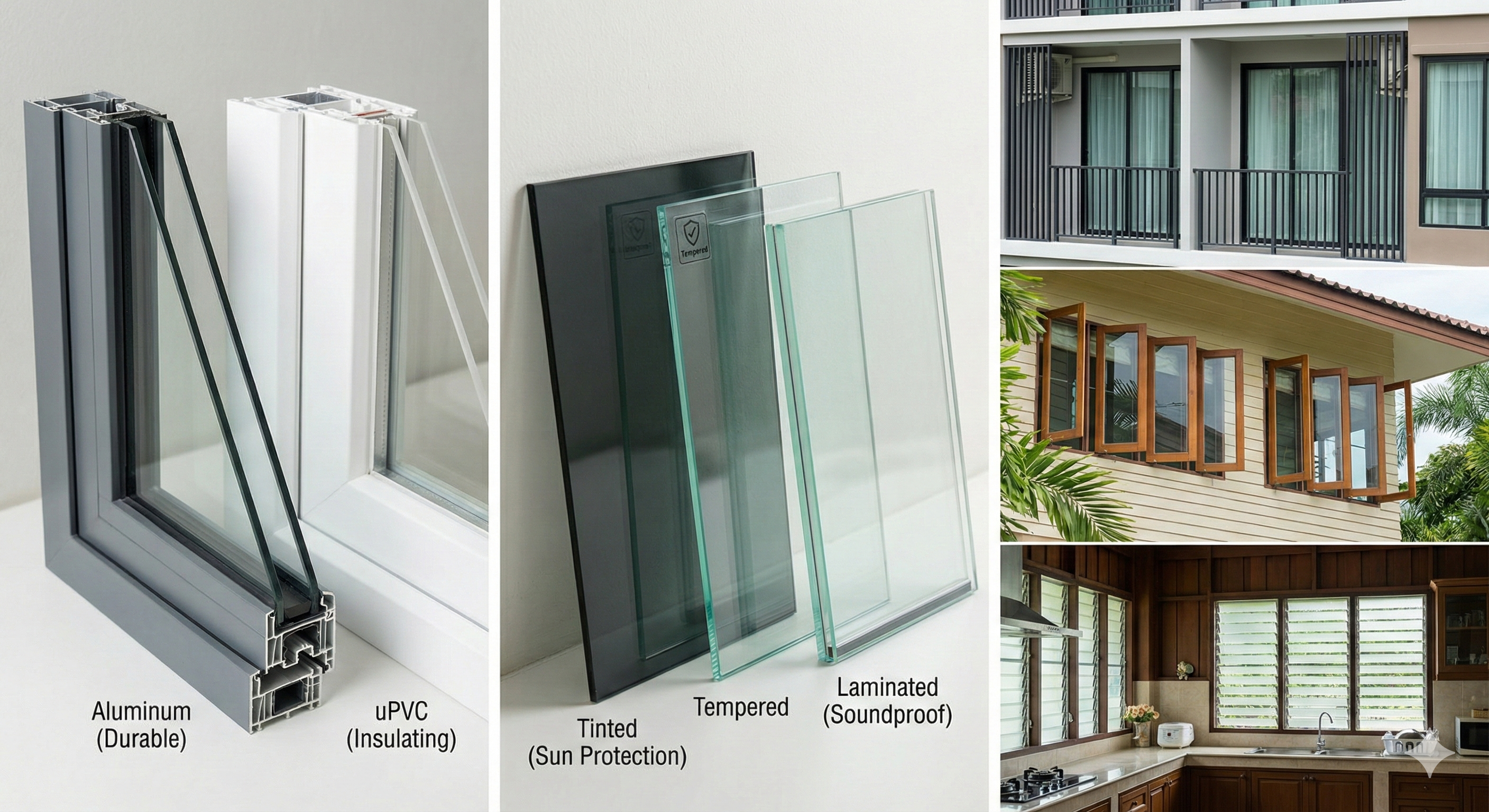
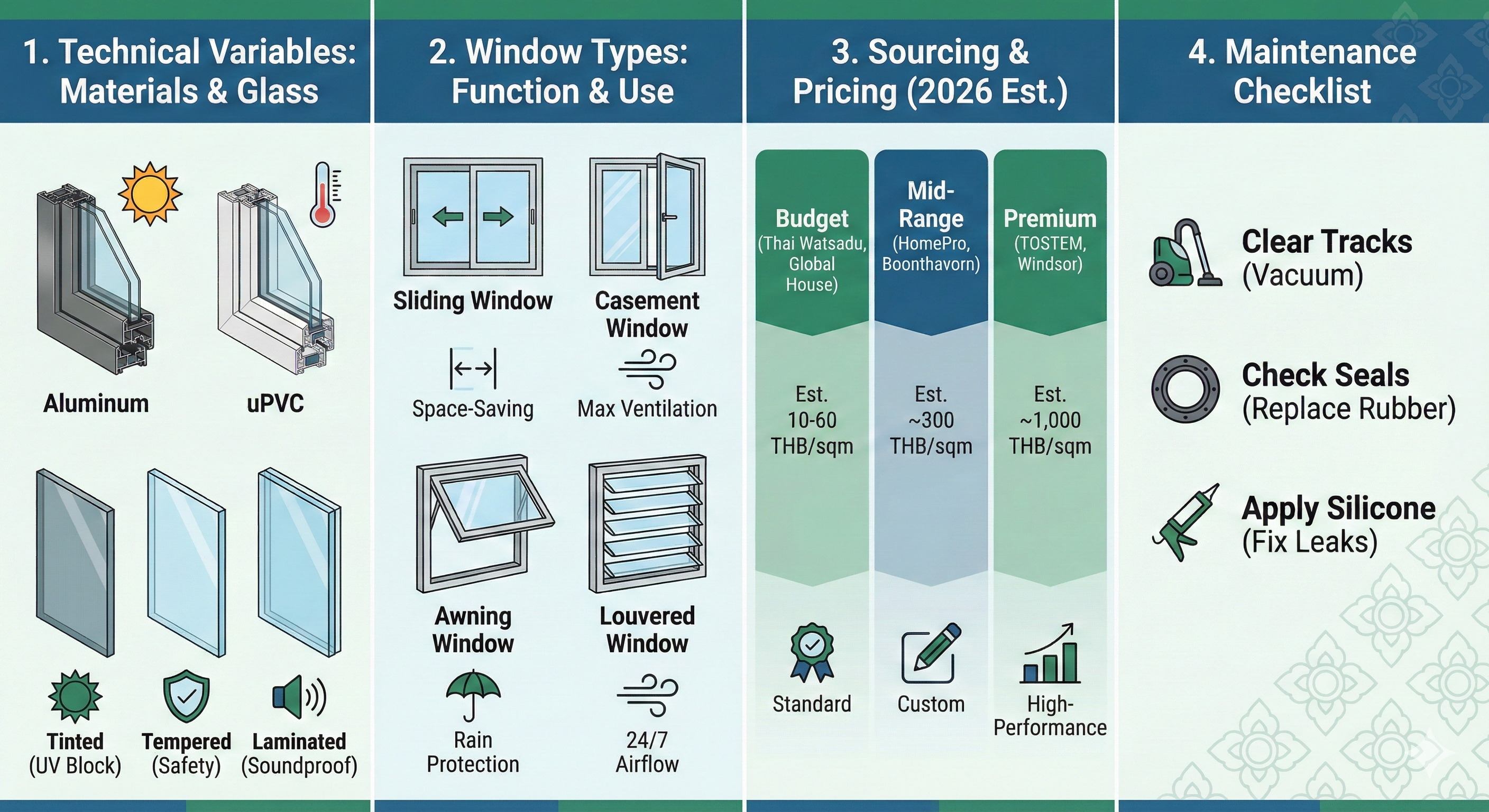
Aluminum: The most common choice in Thailand. It’s lightweight, won't rust in coastal humidity, and is fire-resistant. Why it matters: It’s thin and sleek, allowing for larger glass panes and better views, but it can get hot to the touch.
-
uPVC (Unplasticized Polyvinyl Chloride): A high-grade, rigid plastic reinforced with steel. Think of uPVC like a thermal flask; it doesn't transfer heat from the outside into your air-conditioned room as easily as metal does.
-
Hardwood: Traditional and beautiful, but high-maintenance. It can warp or rot in the monsoon season unless it's top-tier (and expensive) teak.
Glass Types: The Shield
-
Tinted/Reflective: Acts like "sunscreen" for your room, blocking UV rays. Essential for west-facing rooms to prevent your furniture from fading and your room from overheating.
-
Tempered Glass: This is "Safety Glass." It is 4–5 times stronger than regular glass. If it breaks, it shatters into small, blunt pebbles rather than dangerous sharp shards.
-
Laminated Glass: Two layers of glass with a plastic film sandwiched in the middle. It’s the "security" option—it stays in the frame even if cracked and blocks out significant city noise (perfect for Bangkok living).
Window Types: Which One Fits Your Life?
Choosing a window style is like choosing a car—you pick the one that fits your "driving" (living) conditions.
| Window Type | Best Use Case | The "Why it Matters" Factor |
| Sliding | Condos & Tight Spaces | They don't swing out, saving balcony space. Easy to use but harder to seal perfectly against heavy wind. |
| Casement | Main Houses | Hinged like a door. They catch the breeze and funnel it inside, providing 100% ventilation. |
| Awning | Bedrooms & Bathrooms | Hinged at the top. It acts like a mini-umbrella, allowing you to keep the window open for air even during a light tropical rain. |
| Louvered (Jalousie) | Kitchens & Older Homes | Slanted glass slats. These provide 24/7 airflow, which is great for "breathing" houses, though they are the least secure. |
| Fixed | High Walls / Stairwells | These don't open. They are purely for letting in light and have the best seal against rain and heat. |
Sourcing & Market Data: Where to Buy in Thailand
You don't need to be a professional contractor to find quality windows. Thailand has excellent retail and specialized options.
Top Suppliers
-
Budget (The DIY Route): Thai Watsadu and Global House. These are the "Big Box" stores. They are best for "ready-to-install" standard sizes (e.g., 100cm x 110cm) that you can buy and take home today.
-
Mid-Range (Custom & Service): HomePro and Boonthavorn. These retailers offer a better selection of styles and more reliable in-house installation services for residential renovations.
-
Premium (The Professional Grade): TOSTEM (Japanese Engineering) and Windsor (SCG Brand). These brands are the "luxury cars" of windows. They offer high-weather-resistance systems designed specifically to withstand 150km/h winds and torrential monsoon rain.
2026 Pricing Tiers (Estimated)
Note: Prices are per square meter (sqm) to help you estimate your total project cost.
| Quality Tier | Estimated Price (THB/sqm) | What You Get |
| Economy Aluminum | ฿2,200 – ฿3,800 | Basic sliding units, 5mm tinted glass. |
| Standard uPVC | ฿3,500 – ฿5,500 | Better heat insulation, double-locking systems. |
| High-Performance | ฿7,000 – ฿12,000+ | Soundproofing, laminated safety glass, premium seals. |
The Installation Factor: Always budget an extra ฿800 – ฿1,500 per unit for professional installation. A poorly sealed window will "sweat" or leak during a storm, leading to moldy walls and ruined paint.
Maintenance: The "Layman's" Checklist
You don't need to be a builder to keep your windows working like new. Just remember these three simple steps:
-
Clear the Tracks: Dust, sand, and lizard droppings often clog the sliding tracks. Vacuum them once a month so the rollers don't get stuck and break.
-
Check the Rubber Seals: The black rubber "gaskets" around the glass will eventually dry out and crack in the Thai sun. If you see gaps, it's time to call a handyman to replace them before the next rainy season.
-
The Silicone Quick-Fix: If you notice water seeping in through the wall joint during a storm, a 120-baht tube of outdoor-grade silicone from the hardware store can usually solve the problem instantly.
Summary & Next Steps
Selecting windows in Thailand is a balance between airflow and insulation. If you live in a noisy city like Pattaya or Bangkok, prioritize laminated glass. If you live in the breezy countryside of Chiang Mai, go for casement windows to catch those mountain winds.