
February 25th, 2026 - Zed van der Vyver
The Ultimate Guide to Construction Fasteners: Holding Your World Together
If you’re starting a home DIY project or managing a construction site, you quickly realize that the "glue" holding everything together isn't actually glue—it’s a massive variety of metal pins, bolts, and screws. These are fasteners, and choosing the wrong one is the difference between a sturdy deck and a structural collapse.
Think of fasteners like the buttons and zippers on your clothes. Some are meant to be permanent, some need to be undone easily, and some are heavy-duty enough to hold up a winter coat (or in this case, a literal roof).
The Technical Breakdown: Understanding the "Moving Parts"
Before you fill your bucket at the hardware store, you need to know which variable matters for your specific job.
The Anatomy of a Fastener
-
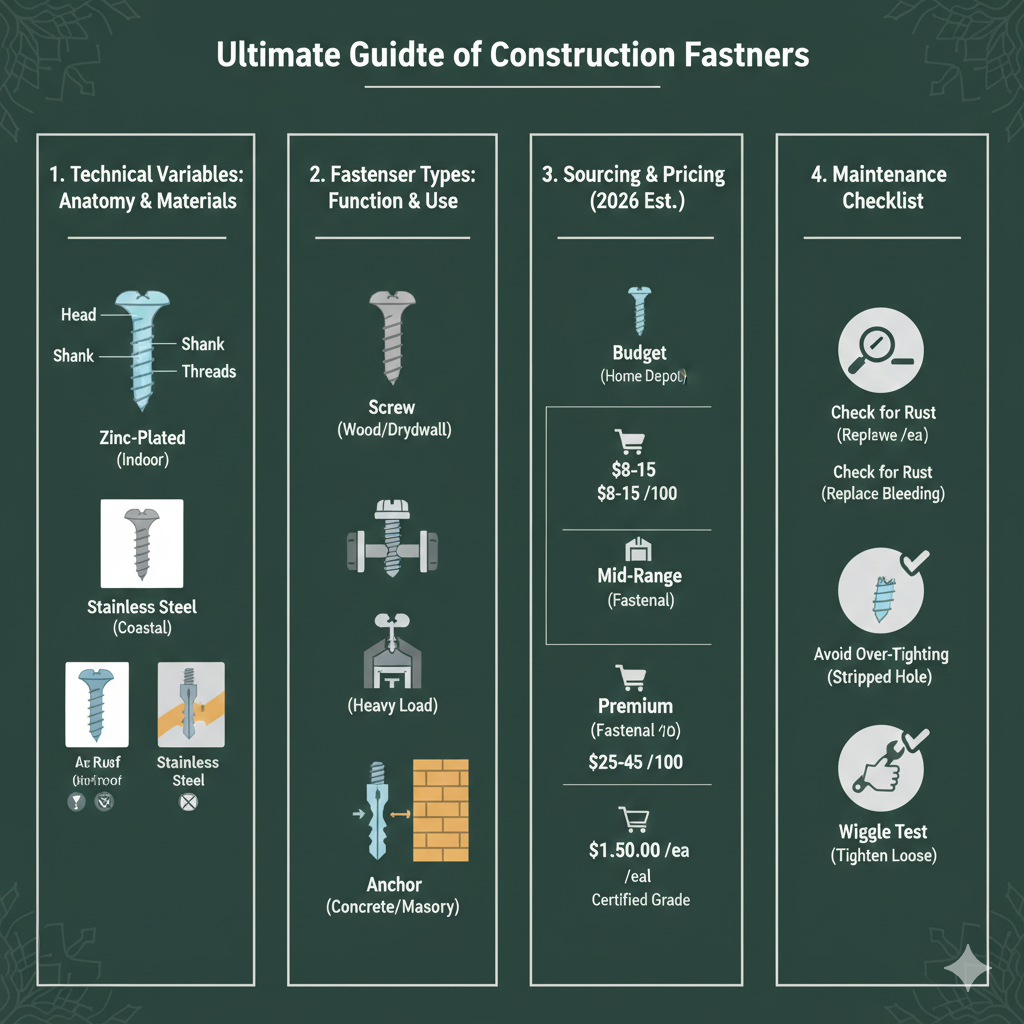
The Head: The top part where your tool (screwdriver or wrench) connects. Common shapes include Hex (six-sided), Flat (sits flush with the surface), and Pan (rounded top).
-
The Shank/Shaft: The long body. It can be fully threaded (grooves all the way up) or partially threaded (smooth at the top to help pull two boards together).
-
The Material (The "Why it Matters" Factor):
-
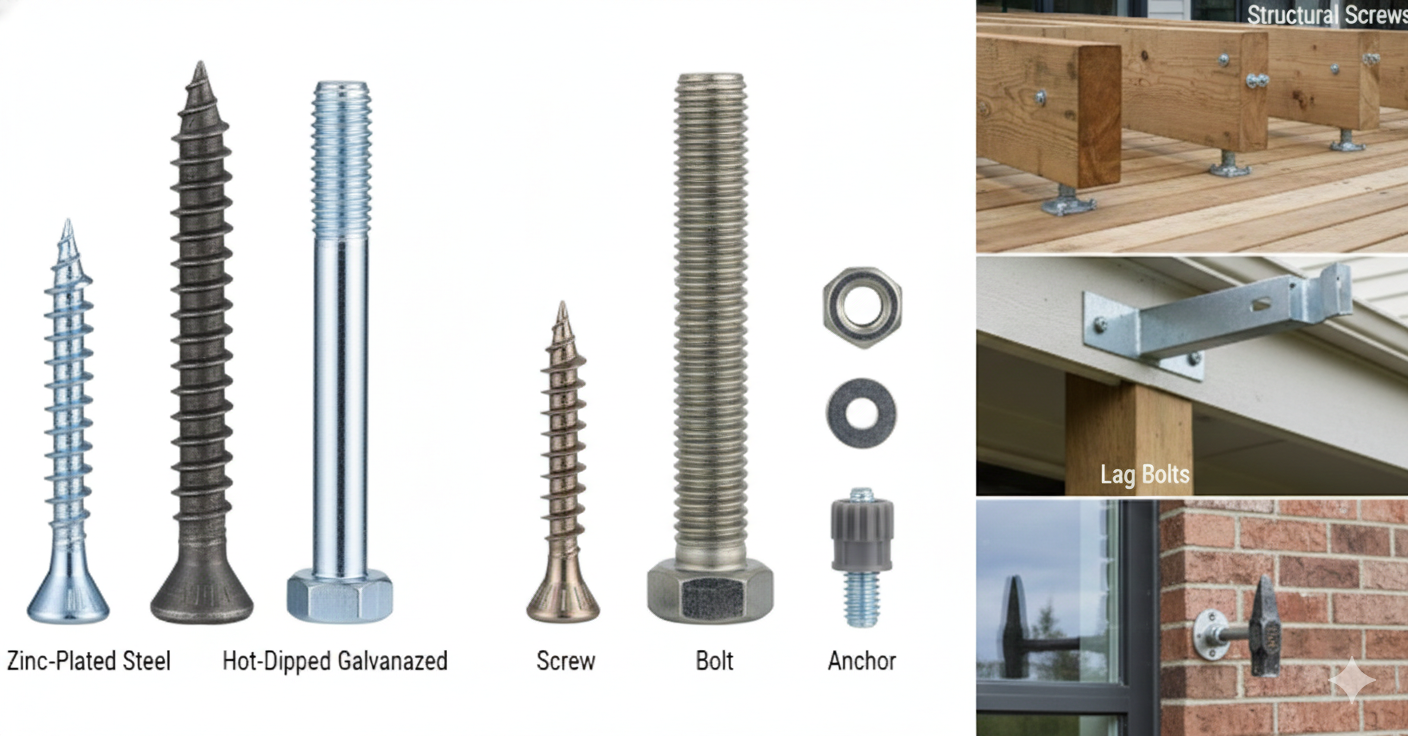
Zinc-Plated Steel: Shiny and cheap. Best for indoor use. It will rust quickly if exposed to rain.
-
Hot-Dipped Galvanized: Dull gray and "crusty" looking. This is your go-to for outdoor wood projects like fences.
-
Stainless Steel: The "Gold Standard." It won’t rust even in coastal salt air, but it’s more expensive.
-
Categorizing the "Big Three"
| Type | Best Use Case | The "Why it Matters" Factor |
| Screws | Wood-to-wood or Drywall | They have sharp threads that "bite" into the material. They don't need a nut to stay in place. |
| Bolts | Heavy Steel or Structural Timber | They pass all the way through and require a Nut on the other side. They handle much more weight than screws. |
| Anchors | Brick, Concrete, or Stone | These "expand" inside a pre-drilled hole. Think of them like a rock climber’s grip; they won't pull out once set. |
Choosing the Right Tool: Structural Screws vs. Lag Bolts
In the past, if you wanted to build a deck, you used Lag Bolts (those fat, heavy bolts with hex heads). Today, most pros use Structural Screws.
-
Lag Bolts: Require "pre-drilling" a hole first. They are cheap but slow to install.
-
Structural Screws: Thinner, stronger, and "self-drilling." They go in like butter and don't require a pilot hole.
-
Analogy: Using a Lag Bolt is like drilling a hole for a peg; using a Structural Screw is like driving a high-tech needle through fabric.
Sourcing & Market Data: Where to Buy in 2026
Fasteners are sold by the box or by weight. For a small project, a local hardware store is fine. For a big build, go to a specialist.
Top Suppliers
-
Budget (General Retail): Home Depot, Lowe’s, or Bunnings. Best for standard wood screws and household anchors. Great for "grab-and-go" needs.
-
Mid-Range (Contractor Grade): Fastenal or Grainger. These suppliers have every size imaginable and offer "Grade 8" (extremely high-strength) steel.
-
Premium (Specialized Engineering): Hilti or Simpson Strong-Tie. If you are anchoring a skyscraper or a heavy earthquake-proof frame, these are the brands professionals trust for certified safety.
2026 Pricing Tiers (Estimated)
Note: Prices for fasteners are often quoted "per 100 pieces" or "per box."
| Quality Tier | Estimated Price (per 100) | What You Get |
| Basic Interior Screws | $8.00 – $15.00 | Standard zinc screws for furniture or drywall. |
| Exterior/Decking Screws | $25.00 – $45.00 | Coated for rust resistance; usually include a driver bit. |
| Structural/Anchor Bolts | $1.50 – $5.00 (per piece) | Heavy-duty steel for concrete or foundation work. |
Maintenance & Safety: The "Layman's" Checklist
Fasteners are "set and forget," but they aren't immortal. Keep an eye on these three things:
-
The "Bleeding" Sign: If you see dark streaks running down your wood from a screw head, it’s rusting (bleeding). Replace it with a galvanized or stainless version before the wood rots.
-
Don't Over-Tighten: If you hear a "crack" while driving a screw into wood, you’ve stripped the hole. The screw now has zero holding power. Back it out and move it an inch to the side.
-
The "Wiggle" Test: For outdoor structures like play-sets or decks, check the nuts and bolts once a year. Vibration and wood shrinking can loosen them over time.
Summary & Next Steps
Selecting the right fastener is about matching the metal to the environment. If it's outside, go galvanized or stainless. If it’s holding up a heavy beam, use a bolt, not a screw.