
January 28th, 2026 - Zed van der Vyver
The Ultimate Guide to Bricks in Thailand: Building a Home That Doesn't Bake
If you’re building a home or a garden wall in Thailand, you’re not just choosing "blocks"—you’re choosing how much you’ll pay the electric company for the next 20 years. In the tropics, your walls are more than structural; they are your home’s "thermal skin."
Think of your bricks like the insulation in a cooler box. Choose the wrong type, and your house will soak up the afternoon sun and radiate heat into your bedroom all night long. Choose the right one, and you’ll have a sanctuary that stays chilled even in April.
1. The Technical Breakdown: The "Big Three"
In Thailand, you’ll generally choose between three main types of masonry. Each has a specific job, and mixing them is actually common practice.
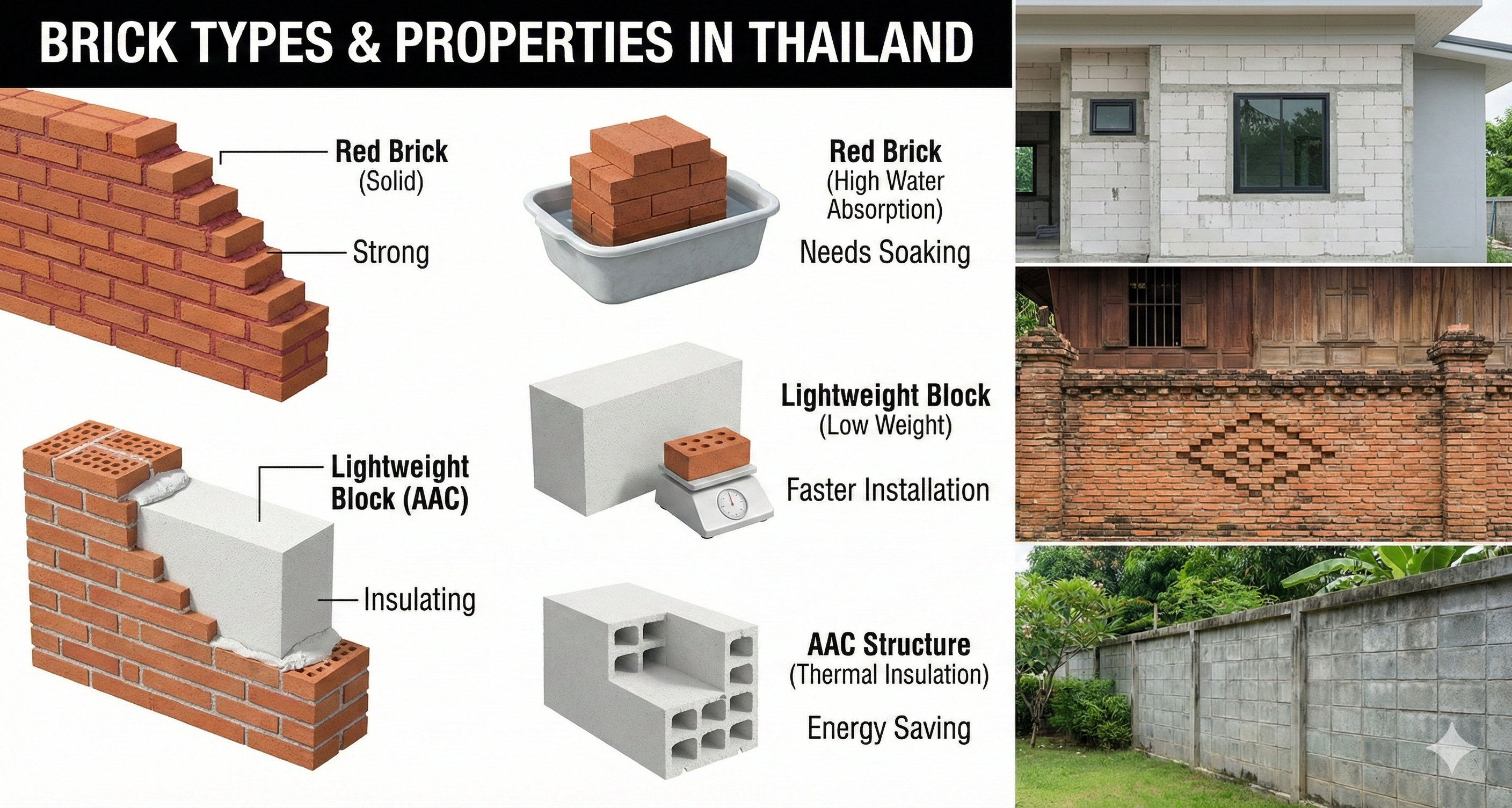
Red Bricks (It-Mon): The Old Reliable
These are the small, orange-red clay bricks you see on every construction site.
-
The Material: Fired clay, sometimes with rice husks mixed in.
-
Why it matters: They are incredibly strong and handle moisture well. However, they are "heat sponges." They soak up the sun and stay warm for hours.
-
Best for: Bathrooms, kitchens (for hanging heavy cabinets), and decorative "loft-style" walls.
Concrete Blocks (It-Block): The Budget Workhorse
The large, grey, hollow blocks commonly used for perimeter fences and low-cost housing.
-
The Material: A mix of cement and sand.
-
Why it matters: They are cheap and fast to stack. Because they are hollow, they offer slightly better airflow than solid red bricks, but they aren't great at stopping heat from entering the home.
-
Best for: Boundary walls, warehouses, or areas where cost is the primary concern.
Lightweight Blocks (AAC): The Modern Shield
These are large, white, "bubbly" blocks that look like giant bars of soap.
-
The Material: Autoclaved Aerated Concrete (AAC).
-
Why it matters: Think of these as the "Styrofoam" of the construction world (but much stronger). They are filled with tiny air bubbles that block heat and sound. They are the gold standard for modern, energy-efficient Thai homes.
-
Best for: Bedroom walls and any exterior wall facing the afternoon sun (West/South).
2. Comparison Table: Which One Fits Your Project?
| Brick Type | Speed of Build | Heat Protection | Budget Level | Best Use Case |
| Red Brick | Slow (Small size) | Low | Low-Mid | Wet areas & heavy shelving. |
| Concrete Block | Fast (Large size) | Medium | Lowest | Fences & simple sheds. |
| Lightweight (AAC) | Very Fast | Excellent | Mid-High | Main house walls & bedrooms. |
3. Sourcing & Market Data: Where to Buy in Thailand
You don't need to hunt through a dusty kiln to find these. Thailand’s hardware infrastructure is world-class.
Top Suppliers
-
The DIY Giants: Thai Watsadu and Global House. These are your one-stop shops. They usually have massive stacks of all three types ready for immediate delivery.
-
The Service Pros: HomePro and Boonthavorn. While they focus more on finishing materials (tiles/taps), they are excellent for sourcing premium AAC blocks like the SCG Q-CON brand.
-
The Specialist: SCG (Siam Cement Group). If you want the highest grade of lightweight blocks with a guaranteed R-value (insulation rating), go directly through an SCG Home Experience center.
2026 Pricing Tiers (Estimated)
Prices can vary by province due to transport costs.
| Quality Tier | Estimated Price (Per Piece) | The "Hidden Cost" |
| Red Brick | ฿1.50 – ฿4.50 | High labor cost (takes forever to lay). |
| Concrete Block | ฿6.00 – ฿12.00 | Requires more plaster/render to look "smooth." |
| Lightweight (AAC) | ฿20.00 – ฿35.00 | Requires special thin-bed mortar and expert labor. |
4. The "Layman's" Installation Secrets
You don't need to be a mason to spot a bad job. Keep these three things in mind:
-
The "Special Glue" Rule: If you use lightweight blocks (AAC), the contractor must use the specific thin-bed mortar designed for it. If they try to use regular "grey cement," your walls will likely crack within a year.
-
The Wetting Trick: Red bricks are thirsty! A good builder will soak them in water before laying them. If they are dry, they will suck the moisture out of the mortar too fast, leading to a weak bond.
-
Lintels are Vital: Ensure your builder uses "Lintels" (reinforced concrete beams) over every door and window. Without them, the weight of the bricks will cause diagonal cracks over your openings—a classic Thai "house-pain" point.
5. Summary & Next Steps
If you are building a "forever home" in Thailand, the smart move is a hybrid approach. Use Lightweight AAC blocks for your exterior walls to keep the house cool, and Red Bricks for your bathrooms and kitchen walls where you’ll be drilling in heavy cabinets or dealing with constant water.