
May 11th, 2026 - Zed van der Vyver
The Ultimate Guide to Home Electricity in Thailand: Powering Your Life Safely
Walking into a Thai hardware store to fix an electrical issue can feel like stepping into a different world. Between the colorful wires, different plug types, and the constant hum of air conditioners, managing your home’s power is more than just flipping a switch—it’s about safety and efficiency.
Think of your home’s electrical system like the circulatory system in your body. The wires are the veins, the circuit breaker is the heart, and the electricity is the blood. If the heart is too weak or the veins are clogged, the whole system fails. In a tropical climate where we rely on heavy-duty appliances like AC units and water heaters, having a "healthy" system is vital.
The Technical Breakdown: Understanding the "Moving Parts"
Before you start plugging in your high-end gadgets, you need to understand the basic variables of the Thai electrical grid.
The Power Supply: Voltage and Frequency
In Thailand, the standard voltage is 220V with a frequency of 50Hz.
-
Why it matters: If you bring electronics from the USA (which uses 110V), plugging them directly into a Thai outlet will likely result in a "pop" and a cloud of smoke. Always check the label on your power brick for "Input: 100-240V."
The "Safety Valve": Circuit Breakers (RCBO)
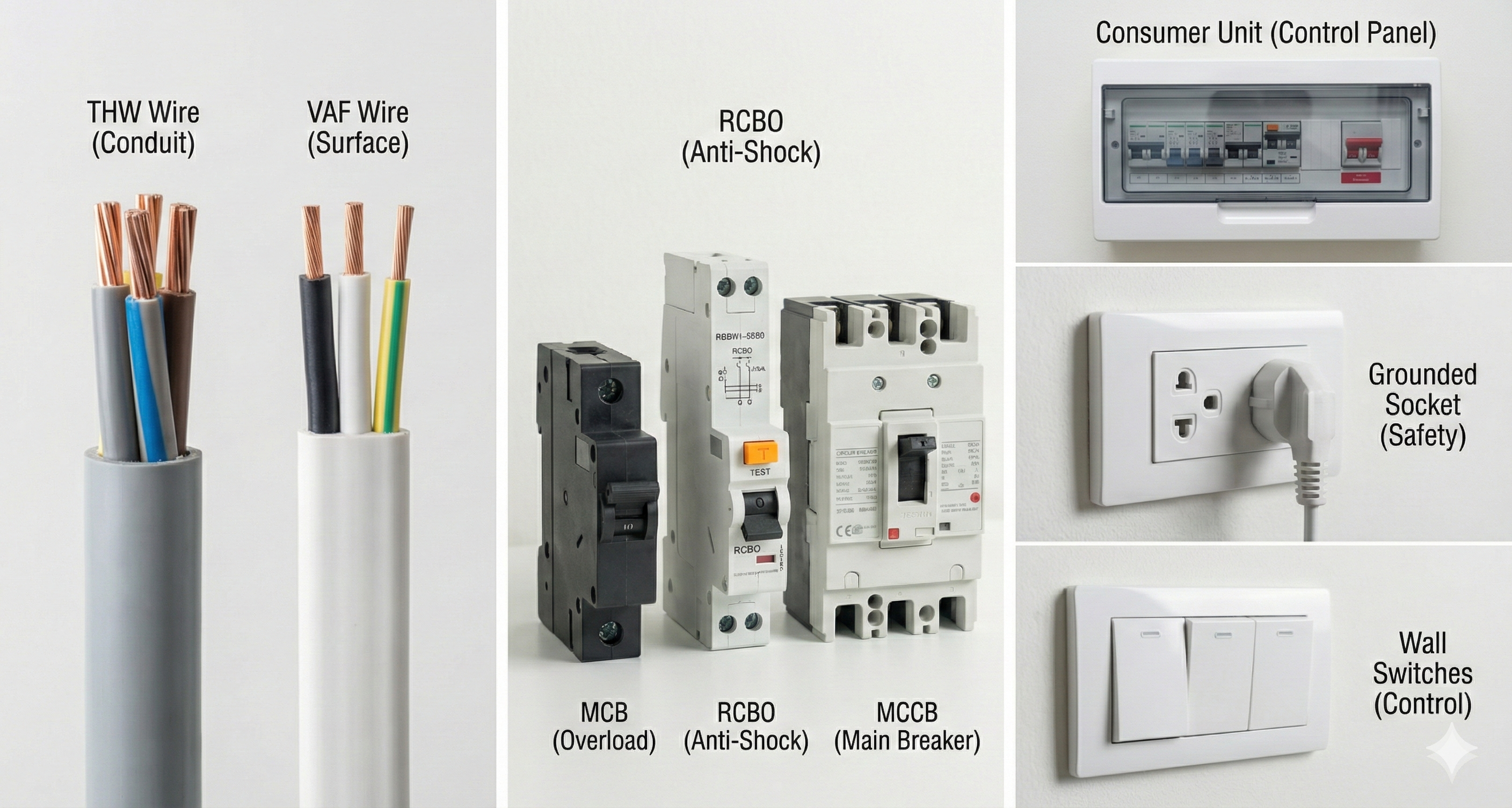
Modern Thai homes use Consumer Units (the metal box on the wall). The most important component is the RCBO (Residual Current Breaker with Overcurrent protection).
-
Why it matters: This is your "life-saver" switch. It detects if electricity is leaking (like through a person) and shuts off the power in milliseconds to prevent electrocution.
The Grounding Wire: The "Escape Path"
Older Thai buildings often lack a third "ground" pin. A ground wire provides a safe path for electricity to travel into the earth if there is a short circuit.
-
Why it matters: Without a ground wire, YOU become the path to the ground. This is why you might feel a "tingle" when touching a metal fridge or a laptop casing.
Component Types: Which One Do You Need?
Not all electrical parts are created equal. Choosing the right "grade" ensures your house doesn't just work, but stays cool and safe.
| Component | Best Use Case | The "Why it Matters" Factor |
| THW Wire | Inside Conduits/Pipes | The standard "vein" for most homes. Must be tucked away inside plastic pipes for protection. |
| VAF Wire | Surface Mounting | Flat white cables often seen clipped to walls in older homes. Easy to install but less protected from moisture. |
| Type B/C Plugs | Modern Appliances | The standard 3-pin plug. The third round pin is the ground; never snap it off to fit a 2-pin socket! |
| Voltage Stabilizers | Rural Areas | If your lights flicker during storms, these "buffers" keep the power steady so your fridge doesn't burn out. |
Sourcing & Market Data: Where to Buy in Thailand
You don't need to be an electrician to buy quality supplies, but you should avoid "no-name" brands from local markets for anything carrying high voltage.
Top Suppliers
-
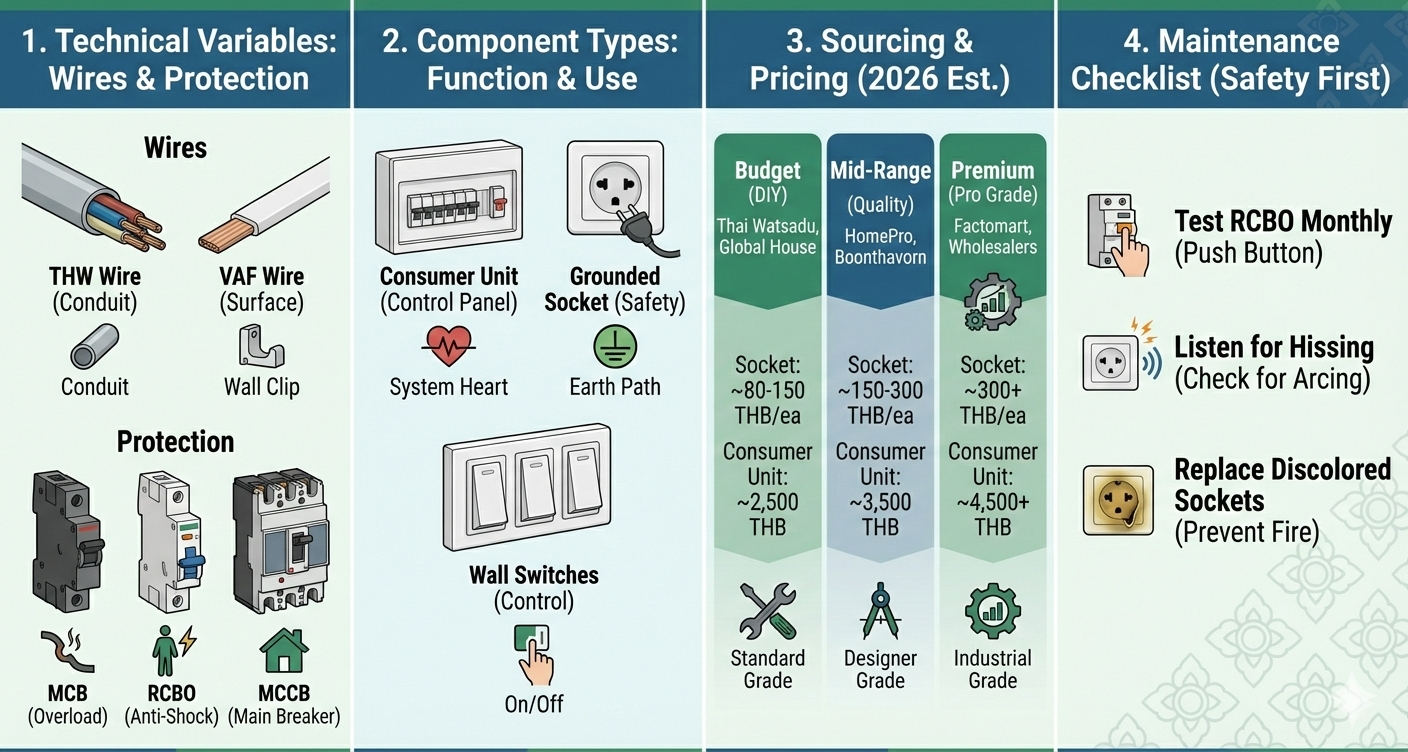
Budget (Standard DIY): Thai Watsadu and Global House. Great for buying bulk wire, PVC conduits, and standard light switches.
-
Mid-Range (Quality & Design): HomePro and Boonthavorn. They carry a wider variety of aesthetic plates (like Panasonic or Schneider) and high-quality LED fixtures.
-
Professional Grade: Factomart or specialized electrical wholesalers. These are best if you are looking for specific industrial-grade breakers or smart-home integration systems.
2026 Pricing Tiers (Estimated)
Note: Prices vary by brand (e.g., Schneider vs. local brands).
| Item Tier | Estimated Price (THB) | What You Get |
| Standard Wall Socket | ฿80 – ฿150 | Basic 3-pin grounded outlet. |
| 12-Way Consumer Unit | ฿2,500 – ฿4,500 | The main box for a medium-sized house. |
| Inverter Air Con (12k BTU) | ฿12,000 – ฿18,000 | Energy efficient; saves 30% on monthly bills. |
The Installation Factor: Never DIY high-voltage work. A licensed electrician usually charges ฿500 – ฿1,500 per "point" (socket or light) for labor.
Safety & Maintenance: The "Layman's" Checklist
Electrical systems in the tropics face high heat and humidity, which can wear down insulation faster than in cooler climates.
-
The "Test" Button: Once a month, press the small "T" or "Test" button on your main breaker. If it clicks and the power goes out, it’s working. If nothing happens, call an electrician immediately—your safety switch is broken.
-
Listen for "Hissing": If a socket makes a sizzling or crackling sound, it means the wires inside are loose and sparking (arcing). This is a leading cause of house fires.
-
The Yellowing Test: If your white plastic outlets are turning yellow or brown, they are overheating. This usually happens when a high-draw appliance (like a toaster or kettle) is used on a cheap, low-grade socket. Replace them before they melt.
Summary & Next Steps
Electricity in Thailand is reliable if your home is "grounded" in good habits. If you are moving into a new place, your first priority should be ensuring the Water Heater in the shower has a dedicated ground wire and a working ELCB (Earth Leakage Circuit Breaker).